
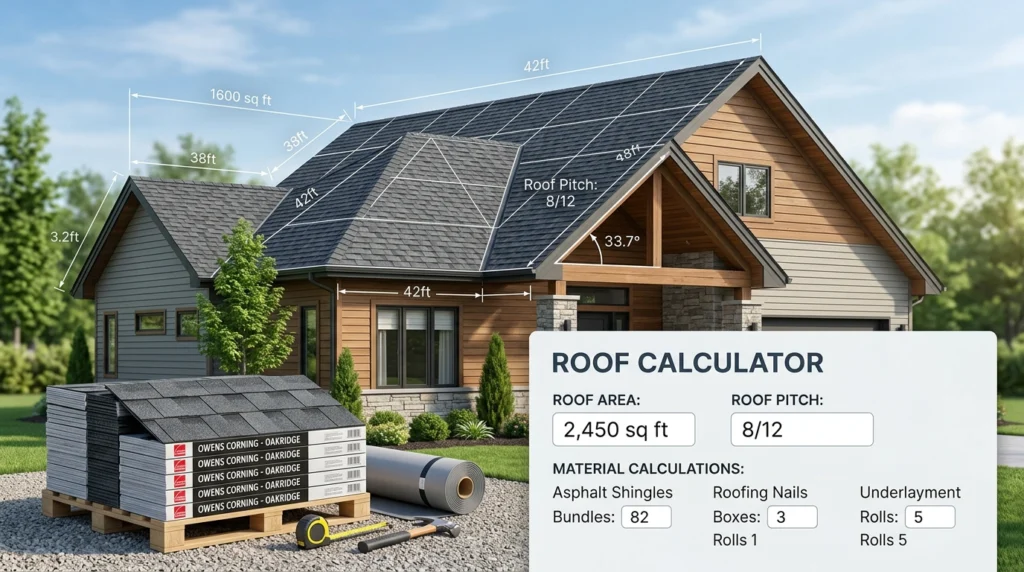
A roof calculator makes it easier to estimate the size of a roof, understand how roof pitch affects its surface area, and work out how much roofing material may be needed. Instead of relying on rough guesses, you can enter your roof measurements and use the results to plan a roofing project more confidently. If you want to make quick calculations yourself, the Roof Calculator can help you estimate the roof area, roofing squares, and material requirements.
What Is a Roof Calculator?
A roof calculator is an online tool that estimates the actual surface area of a roof based on measurements such as length, width, and roof pitch. Depending on the calculator, it may also estimate roofing squares, shingles, bundles, underlayment, waste, and other materials.
One important point is that the roof surface is usually larger than the building’s flat footprint. A sloped roof has an angled surface, so simply multiplying the length by the width does not always give you the amount of roofing surface that needs to be covered.
A roof calculator accounts for the slope to provide a more useful estimate. This can be particularly helpful when planning a new roof, replacing shingles, comparing material quantities, or preparing an initial project budget.
How Does a Roof Calculator Work?
Most basic roof calculations start with the building’s footprint. For a simple rectangular structure, the basic area can be found by multiplying the length by the width.
Base Area = Length × Width
The roof pitch is then used to adjust this flat measurement to account for the slope. A common way to express roof pitch in the United States is rise over 12. For example, a 6/12 roof rises 6 inches for every 12 inches of horizontal run.
The pitch multiplier can be calculated using:
Pitch Multiplier = √(1 + (Rise ÷ 12)²)
The estimated sloped roof area is then:
Roof Area = Base Area × Pitch Multiplier
For example, a 2,000-square-foot footprint with a 6/12 pitch has a pitch multiplier of about 1.118. That means the sloped surface is approximately 2,236 square feet before considering overhangs, waste, or other roof features.
This difference is why using only the building footprint can underestimate the amount of roofing material required.
How to Calculate Roof Area
Calculating roof area manually is possible when you have a simple roof shape and accurate measurements.
Start by measuring the length and width of the building or roof section. If the roof has a straightforward rectangular footprint, multiply those two measurements to get the base area.
Next, determine the roof pitch. If the roof is 6/12, for example, the rise is 6 inches for every 12 inches of horizontal run.
Apply the appropriate pitch multiplier to the base area. This converts the horizontal measurement into an estimate of the actual sloped surface.
For roofs with several sections, such as a roof with different slopes, dormers, additions, or other complicated features, it is generally better to calculate each section separately and then add the results together. Complex roof designs can make a simple footprint calculation less accurate.
What Is Roof Pitch?
Roof pitch describes how steep a roof is. It is commonly written as a ratio such as 4/12, 6/12, or 8/12.
The first number represents the vertical rise, while 12 represents the horizontal run. Therefore, a 6/12 roof rises 6 inches for every 12 inches of horizontal distance.
As the pitch increases, the actual roof surface also becomes larger compared with the horizontal footprint.
For example, a low-slope roof will have a smaller difference between its footprint and actual surface area. A steep roof will have a greater difference.
Knowing the pitch is therefore important when estimating roofing materials. If you do not know your roof pitch, you may be able to determine it from architectural plans or measure it using appropriate tools. For safety, avoid climbing onto a roof simply to obtain a measurement if you are not trained to do so.
What Are Roofing Squares?
Roofing professionals commonly use the term roofing square when discussing material quantities. One roofing square represents 100 square feet of roof surface.
For example, if your estimated roof area is 2,000 square feet:
2,000 ÷ 100 = 20 roofing squares
This makes it easier to discuss material quantities with roofing suppliers and contractors.
Remember that the number of squares is based on the roof surface area, not simply the floor or building footprint. Pitch, overhangs, roof shape, and waste can all affect the final material estimate.
How Many Shingles Do You Need?
Once you know the roof area, you can estimate the number of shingle bundles required. However, you should always check the coverage information printed on the specific shingle product because coverage varies between manufacturers and product types.
A simple calculation is:
Shingle Bundles = Roof Area With Waste ÷ Coverage Per Bundle
For example, suppose your roof requires approximately 2,200 square feet of coverage after accounting for waste. If one bundle covers about 33.3 square feet, you would divide 2,200 by 33.3 and round the result up to a whole bundle.
Some asphalt shingle products are commonly estimated at around three bundles per roofing square, but this should not be treated as a universal rule. Always use the manufacturer’s stated coverage for the product you intend to purchase.
Don’t Forget Roofing Waste
Ordering exactly the calculated roof area is usually not enough for a real roofing project. Extra material may be needed because of cutting, overlaps, damaged pieces, valleys, hips, ridges, dormers, and other roof details.
This extra amount is commonly called a waste allowance.
For a simple roof, a calculator may allow you to enter a waste percentage. More complicated roofs can require a larger allowance because there are more cuts and irregular sections.
For example:
Roof Area = 2,000 sq ft
Waste Allowance = 10%
Material Area = 2,000 × 1.10 = 2,200 sq ft
The appropriate allowance depends on the roof design and the material being installed. A calculator provides an estimate, but the product manufacturer’s instructions and a qualified roofing professional should be used for final ordering decisions.
What Roofing Materials Can You Estimate?
Depending on the calculator and the information you enter, a roof calculator can help estimate several common roofing materials.
These may include:
- Asphalt shingles
- Metal roofing
- Roofing tiles
- Underlayment
- Ridge caps
- Starter strips
- Drip edge
- Other roofing products
The exact quantity cannot be determined from roof area alone for every material. Product dimensions, coverage, installation requirements, overlaps, and packaging can change the amount needed.
For example, underlayment is sold in rolls with different coverage specifications, while shingles are commonly sold in bundles. It is best to use the coverage information supplied by the manufacturer rather than relying on a generic number.
Roof Calculator Example
Let’s look at a simple example.
Suppose a rectangular building has a footprint of 40 feet by 30 feet and a 6/12 roof pitch.
First, calculate the footprint:
40 × 30 = 1,200 sq ft
For a 6/12 pitch, the approximate pitch multiplier is 1.118.
Now calculate the sloped roof area:
1,200 × 1.118 = 1,342 sq ft
If you then add a 10% allowance:
1,342 × 1.10 = 1,476 sq ft
The estimated material area would therefore be about 1,476 square feet.
To convert this into roofing squares:
1,476 ÷ 100 = 14.76 squares
You would then use the specific roofing product’s coverage information to estimate the number of bundles or packages required.
This example is simplified. Actual roofs may include overhangs, multiple planes, valleys, dormers, skylights, and other features that can change the result.
Why Use a Roof Calculator?
The biggest advantage of a roof calculator is speed. Instead of performing several calculations manually, you can enter your measurements and get an estimate in seconds.
It can also help you:
- Estimate the actual roof surface area
- Understand the effect of roof pitch
- Convert roof area into roofing squares
- Estimate shingle quantities
- Account for material waste
- Compare different roof measurements
- Prepare for a conversation with a roofing contractor
- Create an initial material budget
A calculator is especially useful during the early planning stage when you need a quick estimate before getting a professional quote.
Roof Area vs. Building Footprint
One of the most common mistakes in roof estimation is assuming that the roof area is exactly the same as the building footprint.
Imagine a building with a 1,500-square-foot footprint. If the roof is sloped, its actual surface will be larger than 1,500 square feet.
The steeper the pitch, the greater the difference can become.
Overhangs can also increase the roof dimensions beyond the walls of the building. This is why accurate measurements and the correct pitch are important when estimating materials.
For complicated roofs, each roof plane can be measured separately and then combined for a more realistic estimate.
Is a Roof Calculator Accurate?
A roof calculator can provide a useful estimate when accurate measurements and appropriate assumptions are entered. However, it should not automatically be treated as a final roofing estimate.
The accuracy depends on the information provided. Incorrect dimensions, an incorrect pitch, missing roof sections, or an unsuitable waste allowance can affect the result.
Roofing products also differ in coverage, installation method, and packaging. A final material order should therefore be checked against the manufacturer’s specifications.
For a complex roof, structural work, or an actual construction project, it is sensible to have measurements and material requirements verified by a qualified roofing professional.
Frequently Asked Questions
How do I calculate the area of my roof?
For a simple rectangular roof, start with the length and width of the footprint, calculate the base area, and then apply the appropriate pitch multiplier. More complicated roofs should be divided into individual sections and calculated separately.
What is a roofing square?
A roofing square is a standard roofing measurement equal to 100 square feet of roof surface.
Does roof pitch affect roof area?
Yes. A sloped roof has more surface area than its horizontal footprint. As the pitch becomes steeper, the difference between the footprint and actual roof surface generally increases.
How much extra roofing material should I buy?
The amount of extra material depends on the roof design, material type, installation method, and number of cuts and overlaps. Simple roofs may require less waste allowance than roofs with hips, valleys, dormers, and other complicated features.
Can I use a roof calculator for any roof?
A basic calculator works best for simple roof designs. Complex roofs may need to be broken into multiple sections, and the final measurements should be checked professionally before ordering materials.
Final Thoughts
A roof calculator is a practical way to turn basic measurements into a useful estimate of roof area and roofing materials. By considering the footprint, roof pitch, waste, and product coverage, you can get a much better starting point than simply estimating from the size of the building.
Use the calculator to understand your project and prepare an initial material estimate, but remember that real-world roofs can contain details that a basic calculation cannot fully capture. For major roofing work, always verify measurements, product coverage, and material requirements before making a final purchase.