
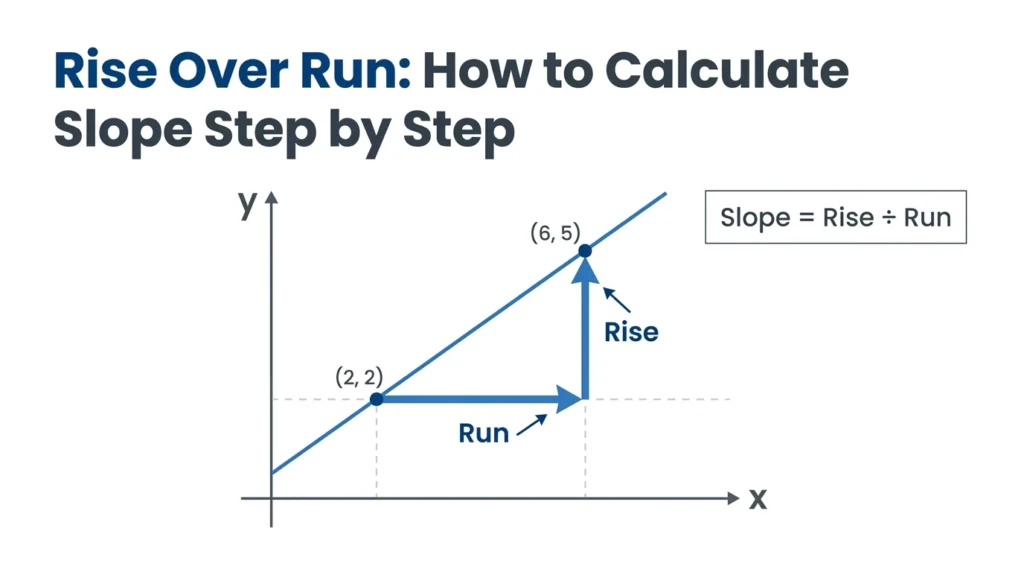
If you have ever looked at a straight line on a graph and wondered how mathematicians describe whether it is steep, flat, or slanted, the answer is slope. One of the easiest ways to understand slope is through the phrase “rise over run.” Rise tells you how much a line moves vertically, while run tells you how much it moves horizontally. In simple terms, slope is the change in height divided by the change in distance across. If you want to check your calculation quickly, a Rise Over Run Calculator can also help you find the slope from two points.
What Does Rise Over Run Mean?
“Rise over run” is a simple way to remember the slope formula:
Slope = Rise ÷ Run
The rise is the vertical change between two points. It tells you how far the line moves up or down.
The run is the horizontal change between those same two points. It tells you how far the line moves from left to right.
So, if a line rises 6 units while moving 3 units to the right, its slope is:
Slope = 6 ÷ 3 = 2
This means the line goes up 2 units for every 1 unit it moves horizontally.
The same idea is used when finding slope from a graph or from the coordinates of two points. OpenStax also defines slope as rise divided by run and explains that the rise represents vertical change while the run represents horizontal change.
What Is Slope?
Slope is a number that describes the direction and steepness of a straight line.
A positive slope means the line goes upward as you move from left to right. A negative slope means the line goes downward. A horizontal line has a slope of zero, while a vertical line has an undefined slope because its horizontal change is zero.
For example, imagine two roads:
- Road A rises 2 meters for every 10 meters forward.
- Road B rises 5 meters for every 10 meters forward.
Road B has the greater slope, so it is steeper.
This is why slope is useful beyond classroom mathematics. It can describe the steepness of roads, ramps, roofs, stairs, and many other structures.
The Rise Over Run Formula
When you know two points on a line, you can calculate the slope with this formula:
m = (y₂ − y₁) ÷ (x₂ − x₁)
Here:
- m = slope
- x₁, y₁ = coordinates of the first point
- x₂, y₂ = coordinates of the second point
- y₂ − y₁ = rise
- x₂ − x₁ = run
The formula may look complicated at first, but it is really just another way of writing rise over run.
The important thing is to subtract the coordinates in the same order. If you subtract the second y-value from the first, you must also subtract the second x-value from the first.
How to Calculate Slope Step by Step
Let’s work through a simple example.
Suppose a line passes through these two points:
(2, 3) and (6, 11)
Step 1: Identify the two points
The first point is:
(x₁, y₁) = (2, 3)
The second point is:
(x₂, y₂) = (6, 11)
Step 2: Find the rise
Subtract the first y-value from the second y-value:
Rise = 11 − 3 = 8
The line rises 8 units.
Step 3: Find the run
Now subtract the first x-value from the second x-value:
Run = 6 − 2 = 4
The line moves 4 units horizontally.
Step 4: Divide rise by run
Now use the rise-over-run formula:
Slope = 8 ÷ 4
Slope = 2
So, the slope of the line is 2.
This means that for every 1 unit the line moves to the right, it moves 2 units upward.
How to Find Rise Over Run From a Graph
You can also calculate slope directly from a graph.
First, choose two points that clearly lie on the line. Points that fall exactly on grid intersections are usually easiest to use.
Then imagine moving from the first point to the second.
Count how many spaces you move up or down. That is the rise.
Next, count how many spaces you move left or right. That is the run.
Finally, divide the rise by the run.
For example, suppose you move:
- 4 units upward
- 2 units to the right
Then:
Slope = 4 ÷ 2 = 2
This graph-based method is essentially the same procedure used in the coordinate formula. OpenStax recommends identifying two points, counting the vertical and horizontal changes, and then taking their ratio.
How to Calculate a Negative Slope
Not every line rises from left to right. Some lines go downward.
Suppose you have these points:
(1, 8) and (5, 4)
Calculate the rise:
4 − 8 = −4
Calculate the run:
5 − 1 = 4
Now divide:
Slope = −4 ÷ 4 = −1
The slope is −1.
The negative sign tells you that the line falls as you move from left to right.
A useful way to remember this is:
Positive slope = line goes up
Negative slope = line goes down
Zero slope = horizontal line
Undefined slope = vertical line
What Is a Zero Slope?
A horizontal line does not move upward or downward. Its y-value stays the same.
For example, consider:
(2, 5) and (8, 5)
The rise is:
5 − 5 = 0
The run is:
8 − 2 = 6
Therefore:
Slope = 0 ÷ 6 = 0
So, the slope is 0.
A zero slope simply means there is no vertical change.
What Is an Undefined Slope?
A vertical line is different because it has no horizontal movement.
Consider these points:
(4, 2) and (4, 9)
The rise is:
9 − 2 = 7
The run is:
4 − 4 = 0
That gives:
Slope = 7 ÷ 0
Division by zero is undefined, so the slope of a vertical line is undefined.
This is an important distinction: an undefined slope is not the same as a slope of zero.
Rise Over Run Example With a Fraction
Slope does not always have to be a whole number.
Suppose a line rises 3 units and runs 5 units.
Then:
Slope = 3 ÷ 5
So the slope is:
3/5
This means the line rises 3 units for every 5 units of horizontal movement.
You may also see a slope written as a decimal:
3 ÷ 5 = 0.6
Both 3/5 and 0.6 represent the same slope.
Keeping the fraction can sometimes make the relationship between rise and run easier to understand.
Common Mistakes When Calculating Slope
Calculating slope is straightforward, but a few small mistakes can change the answer.
Mixing Up Rise and Run
Remember that rise is the vertical change and run is the horizontal change.
A simple memory trick is:
Rise = up and down
Run = left and right
Reversing Only One Subtraction
If you use:
y₂ − y₁
for the rise, use:
x₂ − x₁
for the run.
Don’t reverse the order in only one part of the formula.
Forgetting the Negative Sign
If the line moves downward from left to right, the rise is negative. Do not remove the negative sign just because the distance itself looks positive.
Using the Wrong Points
Choose two points that actually lie on the line. On a graph, points at clear grid intersections are usually easier to work with accurately.
Why Is Rise Over Run Important?
Rise over run is more than a formula students memorize for a math test. It gives you a simple way to describe how one quantity changes compared with another.
In coordinate geometry, slope helps describe linear relationships. In practical situations, similar ideas can be used to describe the steepness of roads, ramps, roofs, and other surfaces.
For example, if a ramp rises 1 foot over a horizontal distance of 12 feet, its slope can be represented as:
1/12
The same basic relationship can be expressed as a fraction, decimal, percentage, or angle depending on the situation.
Rise Over Run vs. Slope
You may hear people use “rise over run” and “slope” almost interchangeably, but there is a small difference in how the terms are used.
Slope is the value that describes the rate of change.
Rise over run describes the method used to calculate that value.
For example, if a line rises 10 units and runs 5 units:
Rise over run = 10/5
Slope = 2
So, “rise over run” is the calculation, while “2” is the resulting slope.
Frequently Asked Questions
What is the formula for rise over run?
The formula is slope = rise ÷ run. When using two coordinate points, it becomes m = (y₂ − y₁) ÷ (x₂ − x₁).
Is rise always positive?
No. If the line moves downward as you move from left to right, the rise is negative. This produces a negative slope.
What does a slope of 2 mean?
A slope of 2 means the line rises 2 units for every 1 unit of horizontal movement.
Can slope be a fraction?
Yes. A slope can be a whole number, fraction, decimal, zero, or negative number. A vertical line has an undefined slope.
What is the difference between rise and run?
Rise measures the vertical change between two points, while run measures the horizontal change.
How do I calculate slope from two points?
Subtract the y-values to find the rise, subtract the x-values to find the run, and divide the rise by the run. The result is the slope.
Final Thoughts
Rise over run is one of the simplest ways to understand slope. Once you remember that rise means vertical change and run means horizontal change, the calculation becomes much easier. Start with two points, find the change in y, find the change in x, and divide the two values. Whether you are working through a school math problem or trying to understand the steepness of a real-world surface, this simple method gives you a reliable way to measure slope.
For best results, focus on understanding the relationship rather than simply memorizing the formula. When you know what the rise and run actually represent, calculating slope becomes a much more natural process.