
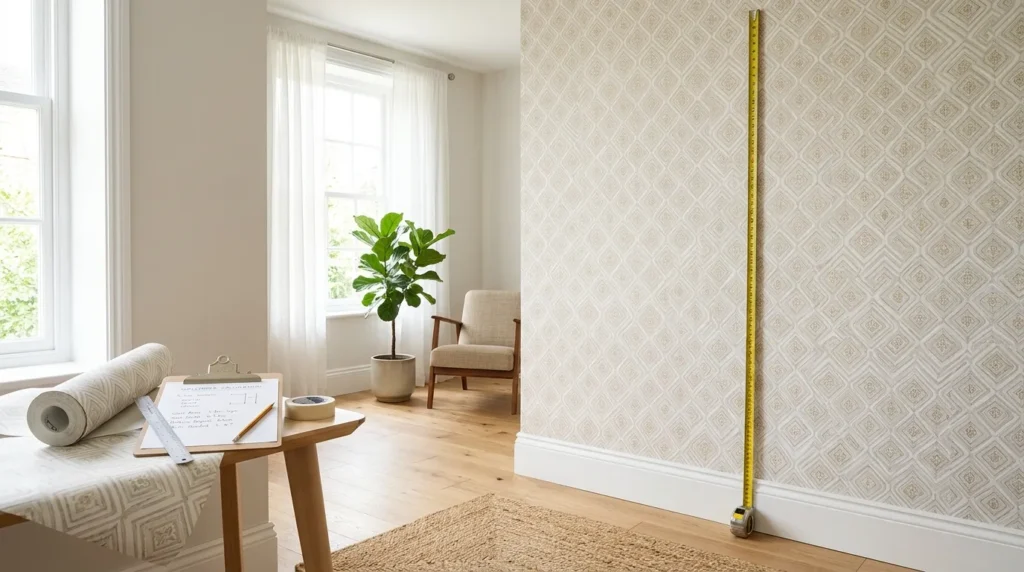
Wallpaper can completely change the appearance of a room, but one of the biggest challenges is figuring out exactly how much you need before placing an order. Buying too little can leave you struggling to find matching wallpaper later, while buying too much can unnecessarily increase your costs. Fortunately, learning how to calculate wallpaper needed is easier than it may seem. By measuring your walls, checking your wallpaper roll size, and allowing for pattern matching and waste, you can make a much more accurate estimate. If you want to save time and avoid doing the calculations manually, you can use a Wallpaper Calculator to quickly estimate the number of rolls required for your project.
Why Accurate Wallpaper Calculations Matter
Wallpaper is different from paint because it is usually installed in vertical strips. This means that simply calculating the total square footage of your walls may not always give you an accurate answer.
Several factors can affect how much wallpaper you need, including:
- The width and height of your walls
- The size of the wallpaper roll
- The number of walls being covered
- Doors and windows
- Pattern repeats
- Extra material needed for trimming and mistakes
A wallpaper with a large repeating pattern may require significantly more material than plain wallpaper. This happens because each strip needs to be positioned correctly so that the pattern matches the strip beside it.
Taking accurate measurements before buying wallpaper can help you avoid running out halfway through your project.
What You Need Before Calculating Wallpaper
Before starting your wallpaper calculations, gather a few basic measurements.
You will need:
- The width of each wall
- The height of the walls
- The width of the wallpaper roll
- The length of the wallpaper roll
- The pattern repeat, if applicable
You can measure your walls using a tape measure. Write down every measurement carefully and use the same unit throughout your calculation.
For example, if you measure your walls in feet, make sure your wallpaper measurements are also converted into compatible units before calculating the number of rolls.
Step 1: Measure the Width of Your Walls
The first step in calculating wallpaper is finding the total width of the walls you want to cover.
Measure each wall individually and add the measurements together.
For example, imagine you have a rectangular room with the following wall measurements:
- Wall 1: 12 feet
- Wall 2: 10 feet
- Wall 3: 12 feet
- Wall 4: 10 feet
The total wall width would be:
12 + 10 + 12 + 10 = 44 feet
You now know that you need enough wallpaper to cover 44 feet of wall width.
If you are only wallpapering one feature wall, simply measure the width of that specific wall instead of the entire room.
Step 2: Measure the Height of Your Walls
Next, measure the height of the walls from the floor to the ceiling.
For example, if your ceiling height is 8 feet, each wallpaper strip will need to be at least 8 feet long. However, it is usually wise to allow extra material for trimming at the top and bottom.
Walls are not always perfectly level, especially in older homes. Measuring carefully and allowing some extra length can help prevent problems during installation.
If different walls have slightly different heights, use the tallest measurement when estimating your wallpaper needs.
Step 3: Check the Size of Your Wallpaper Roll
Wallpaper rolls come in different sizes depending on the manufacturer and country. Always check the product label before making your calculations.
The two most important measurements are:
Roll Width
The width tells you how wide each vertical strip of wallpaper will be.
Roll Length
The length tells you how much wallpaper is available on each roll.
For example, a wallpaper roll may be approximately:
- 20.5 inches wide
- 33 feet long
Other wallpaper products may use completely different measurements, so never assume that every roll provides the same coverage.
Using the exact measurements from the manufacturer’s label will give you a more reliable estimate.
Step 4: Calculate How Many Wallpaper Strips You Need
Wallpaper is normally installed in vertical strips, sometimes called drops.
To estimate the number of strips required, divide the total width of the walls by the width of one wallpaper roll.
The basic formula is:
Number of strips = Total wall width ÷ Wallpaper roll width
Always round your answer up because you cannot buy part of a wallpaper strip.
For example, if your wall is 200 inches wide and your wallpaper roll is 20 inches wide:
200 ÷ 20 = 10 strips
You would need 10 full wallpaper strips.
If the answer was 10.3, you would round up and plan for 11 strips.
This is one of the most important parts of calculating wallpaper because every wall must be completely covered.
Step 5: Calculate How Many Strips You Can Get From One Roll
Once you know how many strips are needed, the next step is determining how many full strips one roll can provide.
Use this formula:
Strips per roll = Roll length ÷ Wall height
Always round down because a partial strip cannot normally be used as a full-height piece of wallpaper.
For example, suppose your wallpaper roll is 33 feet long and your wall is 8 feet high.
33 ÷ 8 = 4.125
This means you can get four full strips from one roll.
The remaining material may be useful for smaller areas, repairs, or other parts of the project, but it should not be counted as another full strip.
Step 6: Calculate How Many Wallpaper Rolls You Need
After calculating the total number of strips required and the number of strips available from each roll, you can estimate the total number of rolls.
Use this formula:
Wallpaper rolls needed = Total strips needed ÷ Strips per roll
Always round up to the next whole roll.
For example:
- Total strips needed: 24
- Strips per roll: 4
24 ÷ 4 = 6
You would need six wallpaper rolls.
If your calculation gave you 6.2 rolls, you would need to buy seven rolls.
It is always better to have slightly more wallpaper than to run out during installation.
How to Calculate Wallpaper Needed With a Pattern Repeat
Calculating wallpaper becomes more complicated when the design has a pattern repeat.
A pattern repeat is the distance before the wallpaper design repeats itself. When hanging patterned wallpaper, each strip must be aligned with the previous strip so the design looks continuous across the wall.
This process can create additional waste.
For example, imagine your wall is 8 feet high, but the pattern repeat requires you to cut a slightly longer strip to ensure the design matches correctly.
This means you may get fewer usable strips from each wallpaper roll.
Large patterns generally create more waste than small patterns. A wallpaper with a simple design or no repeating pattern is usually easier to calculate and install.
Always check the wallpaper label for information about:
- Pattern repeat
- Straight match
- Drop match
- Free match
These details can significantly affect the number of rolls you need.
Understanding Straight Match and Drop Match Wallpaper
Different wallpaper patterns require different matching methods.
Straight Match
A straight match means the pattern lines up horizontally across each strip.
The design begins at the same position on each strip, making the calculation relatively simple compared with more complicated patterns.
However, you still need to allow extra material to ensure the pattern matches correctly.
Drop Match
A drop match pattern is more complicated.
The design shifts between strips instead of lining up directly across them. This can create more waste because alternate strips may need to start at different positions.
Drop match wallpaper often requires additional material compared with plain or straight-match wallpaper.
If your wallpaper has a large drop pattern, consider buying an extra roll to avoid running short.
Should You Subtract Doors and Windows?
Many people wonder whether doors and windows should be removed from wallpaper calculations.
The answer depends on the size and location of the openings and the method you are using to estimate the wallpaper.
Wallpaper is installed in full vertical strips, and openings are often cut out after the strip has been placed on the wall. Because of this, a small window or door does not always reduce the number of full strips you need.
However, very large openings may affect your calculations.
For a simple estimate, you can measure the complete wall area and then allow some extra wallpaper for waste. If you are purchasing expensive wallpaper, using a calculator that considers wall dimensions, roll size, and pattern repeat can provide a more detailed estimate.
How Much Extra Wallpaper Should You Buy?
Buying a little extra wallpaper is usually a smart idea.
Extra material can be useful for:
- Installation mistakes
- Pattern matching
- Trimming
- Damaged sections
- Future repairs
One important reason to buy enough wallpaper at the same time is that different production batches can sometimes have slight variations in color or appearance.
If you run out and purchase more wallpaper later, the new roll may not perfectly match the wallpaper already installed.
For this reason, many homeowners prefer to keep at least one extra roll, particularly when using expensive or patterned wallpaper.
Common Mistakes When Calculating Wallpaper
Avoiding a few common mistakes can help you get more accurate wallpaper calculations.
Forgetting the Pattern Repeat
This is one of the biggest mistakes people make. A repeating pattern can reduce the number of usable strips available from each roll.
Using Only Square Footage
Square footage can provide a general estimate, but wallpaper is installed in vertical strips. Strip calculations often provide a more realistic estimate.
Forgetting to Round Up
Always round up when calculating the number of strips or rolls needed.
Buying too little wallpaper can create bigger problems than buying a small amount extra.
Not Checking the Roll Size
Different manufacturers use different roll dimensions. Always use the measurements printed on the product label.
Not Allowing for Mistakes
Wallpaper installation involves cutting and trimming. Having extra material can save you from needing to order more later.
A Simple Wallpaper Calculation Example
Let’s look at a basic example.
Suppose you are wallpapering a room with:
- Total wall width: 40 feet
- Wall height: 8 feet
- Wallpaper width: 20 inches
- Wallpaper roll length: 33 feet
First, convert the measurements into compatible units.
40 feet equals 480 inches.
Now calculate the number of strips:
480 ÷ 20 = 24 strips
Next, calculate how many strips you can get from one roll.
33 feet ÷ 8 feet = approximately 4 full strips
Finally:
24 ÷ 4 = 6 rolls
In this example, you would need approximately six rolls before considering pattern matching or additional waste.
If the wallpaper has a large repeating pattern, you may need additional material.
Use a Wallpaper Calculator for Faster Results
Manual calculations are useful for understanding how wallpaper measurements work, but they can become confusing when you need to consider multiple walls, different roll sizes, and repeating patterns.
A Wallpaper Calculator can make the process much easier.
Simply enter your wall measurements and wallpaper dimensions, and the calculator can help estimate the amount of wallpaper required for your project.
This is especially useful when you want a quick estimate before purchasing wallpaper or comparing different wallpaper products.
Final Thoughts
Learning how to calculate how much wallpaper you need can help you plan your decorating project with greater confidence. Start by measuring the width and height of your walls, check the exact dimensions of the wallpaper roll, calculate the number of strips required, and determine how many strips each roll can provide.
Remember that pattern repeats, trimming, and installation waste can increase the amount of wallpaper needed. When in doubt, it is usually safer to allow extra material rather than risk running out.
Whether you are decorating a single feature wall, a bedroom, or an entire home, accurate wallpaper calculations can save time, reduce unnecessary costs, and make your project much easier to manage. Using your measurements carefully and checking the manufacturer’s wallpaper specifications will help you choose the right number of rolls before you begin.
For a faster estimate, use a reliable Wallpaper Calculator and enter your specific wall and roll measurements to get a more practical starting point for your project.