
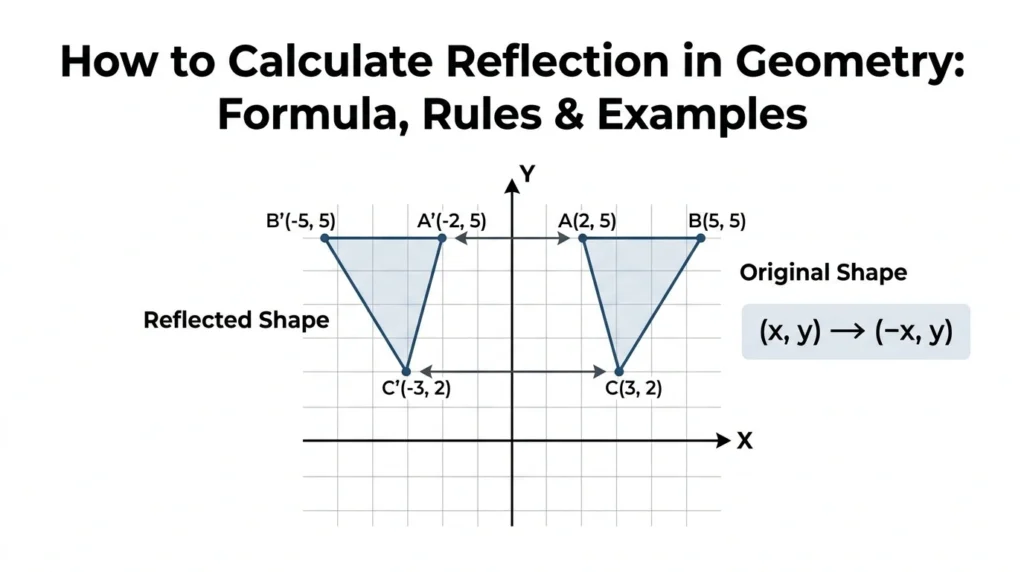
Reflection is a geometric transformation that flips a point, line, or shape across a specific line to create a mirror image. The original figure and its reflected image have the same size and shape, but their positions and orientations change. Once you understand which coordinates change, reflection problems become much easier to solve. For quick coordinate calculations, you can also use a Reflection Calculator.
What Is Reflection in Geometry?
In geometry, a reflection is a transformation that creates a mirror image of a figure across a line. The line used for the flip is called the line of reflection or mirror line. Every point in the original figure moves to the opposite side of this line while staying the same perpendicular distance from it.
For example, imagine a point located 3 units above the x-axis. If that point is reflected across the x-axis, its new position will be 3 units below the x-axis. The horizontal position stays unchanged, while the vertical position is reversed.
The original figure is called the preimage, and the new figure created by the reflection is called the image. Reflections preserve the lengths and angles of a figure, so the original and reflected figures are congruent.
How Do You Calculate a Reflection?
The easiest way to calculate a reflection is to identify the line you are reflecting across and then apply the appropriate coordinate rule.
A point on a coordinate plane is normally written as:\[ (x,y) \]
Here, \(x\) represents the horizontal position and \(y\) represents the vertical position. Depending on the mirror line, you may change the sign of one coordinate, keep both coordinates unchanged in sign, or switch their positions.
The four common reflection rules are:
| Line of Reflection | Coordinate Rule |
|---|---|
| x-axis | \((x,y) \rightarrow (x,-y)\) |
| y-axis | \((x,y) \rightarrow (-x,y)\) |
| \(y=x\) | \((x,y) \rightarrow (y,x)\) |
| \(y=-x\) | \((x,y) \rightarrow (-y,-x)\) |
| Remembering these four rules can help you solve many coordinate geometry questions quickly. |
Reflection Over the X-Axis
When a point is reflected over the x-axis, the x-coordinate stays the same and the y-coordinate changes its sign.
The formula is:\[ (x,y) \rightarrow (x,-y) \]
For example, suppose the original point is:\[ A(4,3) \]
The x-coordinate remains 4. The y-coordinate changes from positive 3 to negative 3.
Therefore:\[ A(4,3) \rightarrow A'(4,-3) \]
The point has moved from 3 units above the x-axis to 3 units below it. Its distance from the x-axis remains exactly the same.
If the original point is already below the x-axis, the same rule applies. For example:\[ B(-2,-5) \rightarrow B'(-2,5) \]
Only the sign of the y-coordinate changes.
Reflection Over the Y-Axis
Reflection over the y-axis works in the opposite way. The y-coordinate stays the same, while the x-coordinate changes its sign.
The formula is:\[ (x,y) \rightarrow (-x,y) \]
Suppose the point is:\[ A(5,2) \]
After reflection over the y-axis:\[ A(5,2) \rightarrow A'(-5,2) \]
The point moves from 5 units to the right of the y-axis to 5 units to the left. Its vertical position remains unchanged.
Another example is:\[ B(-3,-4) \rightarrow B'(3,-4) \]
The negative x-coordinate becomes positive, while the y-coordinate remains -4.
A simple way to remember this rule is that when reflecting over the y-axis, the x-coordinate changes.
Reflection Over the Line \(y=x\)
The line \(y=x\) is a diagonal line passing through the origin. Reflection across this line is slightly different from reflection across the coordinate axes.
Instead of changing a sign, you simply switch the x- and y-coordinates.
The formula is:\[ (x,y) \rightarrow (y,x) \]
For example:\[ A(2,6) \]
becomes:\[ A'(6,2) \]
The original x-coordinate of 2 becomes the new y-coordinate, while the original y-coordinate of 6 becomes the new x-coordinate.
Consider another example:\[ B(-4,3) \]
After reflection over \(y=x\):\[ B'(3,-4) \]
Notice that the signs have not changed. The coordinates have only switched places.
Reflection Over the Line \(y=-x\)
Reflection across the line \(y=-x\) requires you to switch the coordinates and change both signs.
The formula is:\[ (x,y) \rightarrow (-y,-x) \]
For example, consider:\[ A(3,5) \]
After reflection:\[ A'(-5,-3) \]
The coordinates switch positions, and both signs change.
Another example is:\[ B(-2,4) \]
The reflected point is:\[ B'(-4,2) \]
This rule may seem harder at first, but it becomes straightforward once you remember that both the order and signs change.
How to Reflect a Shape
The same reflection rules can be used for a complete geometric figure. The important thing is to apply the correct rule to every vertex of the figure.
Suppose a triangle has these coordinates:\[ A(1,2),\quad B(4,2),\quad C(3,5) \]
Now imagine that the triangle needs to be reflected over the x-axis.
The x-axis rule is:\[ (x,y) \rightarrow (x,-y) \]
Apply the rule to point A:\[ A(1,2) \rightarrow A'(1,-2) \]
Apply it to point B:\[ B(4,2) \rightarrow B'(4,-2) \]
Apply it to point C:\[ C(3,5) \rightarrow C'(3,-5) \]
The reflected triangle therefore has the coordinates:\[ A'(1,-2),\quad B'(4,-2),\quad C'(3,-5) \]
When working with a graph, plot these new points and connect them in the same order as the original vertices. The result is the reflected image.
How to Find the Line of Reflection
Sometimes a problem gives you an original point and its reflected point, and you need to determine the line of reflection.
The key idea is that the mirror line is halfway between a point and its reflected image. It also crosses the segment connecting the two points at a right angle.
For example, suppose:\[ P(2,4) \]
is reflected to:\[ P'(2,-4) \]
The x-coordinate stays the same, while the y-coordinate changes sign. This pattern tells us that the reflection is across the x-axis.
Now consider:\[ Q(1,5) \]
and:\[ Q'(5,1) \]
The coordinates have switched places. This indicates reflection across the line \(y=x\).
Looking carefully at what happens to the coordinates is often enough to identify the mirror line.
Reflection Rules for Common Lines
The most useful rules can be summarized in one place:
Reflection over the x-axis:\[ (x,y) \rightarrow (x,-y) \]
Keep the x-coordinate and change the sign of the y-coordinate.
Reflection over the y-axis:\[ (x,y) \rightarrow (-x,y) \]
Change the sign of the x-coordinate and keep the y-coordinate.
Reflection over \(y=x\):\[ (x,y) \rightarrow (y,x) \]
Switch the coordinates without changing their signs.
Reflection over \(y=-x\):\[ (x,y) \rightarrow (-y,-x) \]
Switch the coordinates and change both signs.
These rules are especially useful when solving coordinate geometry problems without drawing a complete graph.
Reflection Across a Horizontal or Vertical Line
Not every reflection takes place across an axis. A figure can also be reflected across a horizontal or vertical line located somewhere else on the coordinate plane.
For a vertical line \(x=a\), the reflection rule is:\[ (x,y) \rightarrow (2a-x,y) \]
For example, if a point \((2,4)\) is reflected across the vertical line \(x=5\), the new x-coordinate is:\[ 2(5)-2=8 \]
So the reflected point is:\[ (8,4) \]
For a horizontal line \(y=b\), the rule is:\[ (x,y) \rightarrow (x,2b-y) \]
These formulas are useful when the mirror line does not pass through the origin.
Why Does a Reflection Keep the Same Size?
A reflection changes the position and orientation of a figure, but it does not stretch or shrink it. The distance between corresponding points remains the same.
For example, if two vertices of a triangle are 6 units apart before reflection, the corresponding reflected vertices will also be 6 units apart. The angles remain unchanged as well.
This is why reflection is known as a rigid transformation. Other common rigid transformations include translations and rotations.
The main visual difference is that the reflected figure faces the opposite direction, much like an object viewed in a mirror.
Common Mistakes When Calculating Reflections
One common mistake is changing the wrong coordinate. When reflecting over the x-axis, it is the y-coordinate that changes, not the x-coordinate. When reflecting over the y-axis, the x-coordinate changes.
Another mistake is forgetting the negative sign. For example, the reflection of \((4,7)\) across the x-axis is \((4,-7)\), not \((-4,7)\).
Students also sometimes change signs when reflecting over \(y=x\). This is unnecessary. For \(y=x\), simply switch the coordinates.
When reflecting a whole shape, make sure the same rule is applied to every vertex. If one point is calculated incorrectly, the entire reflected figure can become distorted.
Quick Reflection Examples
Here are four examples to help you remember the main rules:
Over the x-axis:\[ (6,2) \rightarrow (6,-2) \]
Over the y-axis:\[ (6,2) \rightarrow (-6,2) \]
Over \(y=x\):\[ (6,2) \rightarrow (2,6) \]
Over \(y=-x\):\[ (6,2) \rightarrow (-2,-6) \]
The most important step is to identify the mirror line before changing any coordinates.
Final Thoughts
Learning how to calculate reflection in geometry becomes much easier when you understand the relationship between the mirror line and the coordinates. Reflection over the x-axis changes the sign of the y-coordinate, while reflection over the y-axis changes the sign of the x-coordinate. Reflection over \(y=x\) switches the coordinates, and reflection over \(y=-x\) switches the coordinates while changing both signs. For a complete shape, apply the correct rule to every vertex and then connect the new points in the same order. With a little practice, these reflection formulas become quick to recognize and use, making coordinate geometry problems much simpler.