
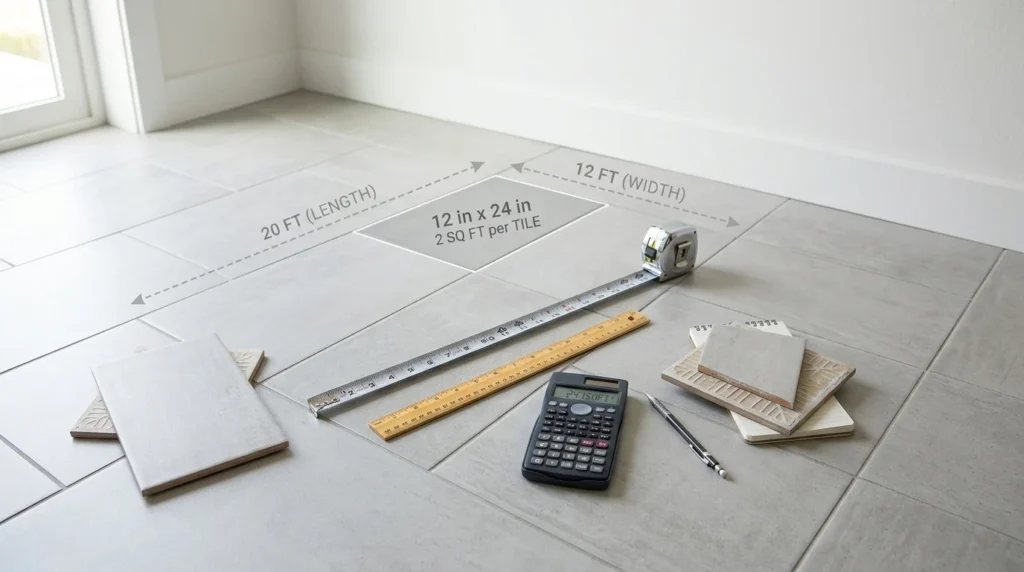
Calculating how many tiles you need before starting a flooring or wall project can help you avoid buying too much material or running out halfway through the installation. The basic process involves measuring the area, determining how much space each tile covers, and adding an appropriate allowance for cuts, breakage, and future repairs. You can use a Tile Calculator to make the calculation faster, but understanding the method also helps you check your results and plan your project with confidence.
Why Is It Important to Calculate Tiles Before Buying?
Buying the correct amount of tile is more than simply estimating how many boxes might look sufficient. Tiles are sold in different sizes, and rooms often have corners, doorways, fixtures, and irregular sections that require cutting. Some tiles may also break during transportation or installation.
If you purchase too few tiles, finding an exact match later can be difficult because tile colors, patterns, and finishes may vary between production batches. On the other hand, buying significantly more than necessary can increase your project cost and leave you with unnecessary material.
A good tile estimate accounts for the total surface area as well as a reasonable waste allowance.
How to Measure the Area for Tiles
The first step is measuring the surface you plan to cover. For a simple rectangular floor, measure the length and width of the room.
Use this formula:
Area = Length × Width
For example, suppose a room is 12 feet long and 10 feet wide:
12 × 10 = 120 square feet
The floor area is therefore 120 square feet.
Measure the room in the same unit throughout the calculation. If you measure in feet, keep the dimensions in feet. If you use meters, keep everything in meters.
For rooms that are not rectangular, divide the floor into smaller rectangular sections. Calculate the area of each section separately and then add the results together.
How to Calculate How Many Tiles You Need
Once you know the total area, determine the coverage of one tile.
For example, if you are using a 12-inch × 12-inch tile, each tile covers one square foot because 12 inches equals one foot.
The basic formula is:
Number of Tiles = Total Area ÷ Area Covered by One Tile
For a 120-square-foot room using 12-inch × 12-inch tiles:
120 ÷ 1 = 120 tiles
This is the theoretical number of tiles needed before accounting for cuts and waste.
For larger tiles, convert their dimensions into the same unit used for the room measurements before calculating the coverage.
How to Calculate Tile Coverage
Tile dimensions are commonly provided in inches, centimeters, or millimeters. To calculate the area of a tile, multiply its length by its width.
For example, a tile measuring 24 inches × 24 inches has an area of:
24 × 24 = 576 square inches
Because one square foot contains 144 square inches:
576 ÷ 144 = 4 square feet
Each 24-inch × 24-inch tile therefore covers 4 square feet.
If the floor is 120 square feet:
120 ÷ 4 = 30 tiles
You would need 30 tiles before adding extra material for waste and cuts.
How to Calculate Tiles for a Wall
The same general method works for walls, but you need to calculate wall area instead of floor area.
For a rectangular wall:
Wall Area = Wall Width × Wall Height
For example, a wall that is 10 feet wide and 8 feet high has:
10 × 8 = 80 square feet
If the wall contains a window or door, calculate its area separately and subtract it from the total wall area when appropriate.
For example, if an 80-square-foot wall contains a 20-square-foot opening:
80 − 20 = 60 square feet
The tile installation area is 60 square feet.
A wall tile calculator can be particularly useful when several walls, openings, or different tile sizes are involved.
How Much Extra Tile Should You Buy?
Your calculated tile requirement should normally include an additional allowance for waste. Tiles may need to be cut around corners, walls, cabinets, plumbing fixtures, door frames, and other obstacles. Some tiles can also crack during cutting or installation.
A common planning allowance is around 10% extra, although the appropriate amount depends on the project.
For a simple rectangular room with minimal cutting, 10% may be sufficient. A room with many corners, angles, or unusual shapes may require more.
For example, if your calculated requirement is 120 tiles and you add 10%:
120 × 0.10 = 12 extra tiles
Therefore:
120 + 12 = 132 tiles
You would plan to purchase approximately 132 tiles.
The manufacturer’s packaging and your installer can also provide useful guidance on the recommended waste allowance.
How to Calculate Tile Waste
Tile waste is usually calculated as a percentage of the required coverage.
The formula is:
Tiles With Waste = Required Tiles × (1 + Waste Percentage)
If you need 200 tiles and want a 10% allowance:
200 × 1.10 = 220 tiles
For a 15% allowance:
200 × 1.15 = 230 tiles
Remember that tiles are often sold by the box rather than individually. After calculating the required number of tiles, check how many tiles are included in each box and round up to a whole box.
Example: Calculating Tiles for a Floor
Suppose you have a rectangular room that measures 15 feet by 12 feet, and you want to install 12-inch × 24-inch tiles.
First, calculate the floor area:
15 × 12 = 180 square feet
A 12-inch × 24-inch tile covers:
1 × 2 = 2 square feet
Now divide the floor area by the tile coverage:
180 ÷ 2 = 90 tiles
If you add 10% for waste:
90 × 1.10 = 99 tiles
You would therefore need approximately 99 tiles, subject to the number of tiles included in each box.
This example demonstrates why calculating both the surface area and individual tile coverage is important.
Factors That Can Affect Your Tile Estimate
Several factors can change the amount of tile required for a project.
Tile size: Larger tiles cover more area per piece, but they may create more cutting waste in small or irregular rooms.
Room shape: A simple rectangle is easier to calculate than a room with multiple corners, alcoves, or unusual sections.
Tile pattern: Straight layouts generally produce less waste than diagonal, staggered, or more complex patterns.
Openings and obstacles: Doors, windows, cabinets, fixtures, and other areas that do not require tile can affect the final quantity.
Tile condition: Breakage during transportation, cutting, or installation can increase the amount of material needed.
Future repairs: Keeping a small number of matching spare tiles can be useful if a tile becomes damaged later.
Common Mistakes When Calculating Tiles
One common mistake is forgetting to add a waste allowance. The mathematical area calculation may be correct, but it does not account for cuts and breakage.
Another mistake is mixing measurement units. For example, using room dimensions in feet while calculating tile coverage in inches without converting the measurements can produce an incorrect result.
It is also important not to round down. If your calculation produces a fraction of a tile or box, you generally need to round up because you cannot purchase a fraction of a physical tile or box.
Finally, check the manufacturer’s packaging information. Two tiles with the same dimensions may be packaged differently, so the number of tiles per box can vary.
Use a Tile Calculator to Make the Process Easier
Manual calculations are useful for understanding the process, but an online calculator can save time when working with different room dimensions, tile sizes, and waste percentages.
The Tile Calculator can help you estimate the number of tiles required based on the measurements you enter. It can also make it easier to experiment with different tile sizes and waste allowances before purchasing materials.
For larger projects, calculate each room or surface separately and keep a record of the results. This makes it easier to compare the estimate with the quantity available from your tile supplier.
Frequently Asked Questions
How many tiles do I need for a 100-square-foot floor?
The number depends on the tile size. A 12-inch × 12-inch tile covers 1 square foot, so 100 tiles would cover 100 square feet before adding waste. A larger tile would require fewer individual pieces.
Should I buy extra tiles?
Yes. Buying extra tiles helps account for cutting, breakage, installation waste, and future repairs. A common starting point is around 10% extra, although complex layouts may require a higher allowance.
How do I calculate tiles for an irregular room?
Divide the room into smaller measurable sections, calculate the area of each section, and add them together. Then calculate the tile requirement and add your chosen waste allowance.
Do I subtract doors and windows from wall tile calculations?
Generally, yes. If a door, window, or other opening will not be tiled, its area can be subtracted from the total wall area. However, you should still consider cuts around the opening when determining waste.
Is a tile calculator accurate?
A tile calculator can provide a useful estimate based on the measurements and information entered. The final amount may vary depending on the room layout, installation pattern, cuts, breakage, tile packaging, and manufacturer’s recommendations.
Final Thoughts
Calculating how many tiles you need starts with accurate measurements and a simple area calculation. Once you know the surface area and the coverage of each tile, you can estimate the number of tiles required and then add an appropriate allowance for waste. Taking the time to calculate your materials before purchasing can reduce unnecessary costs and help prevent delays during installation.
For a quick estimate, use the Tile Calculator to calculate your tile requirements and compare different tile sizes or waste allowances before beginning your project.