
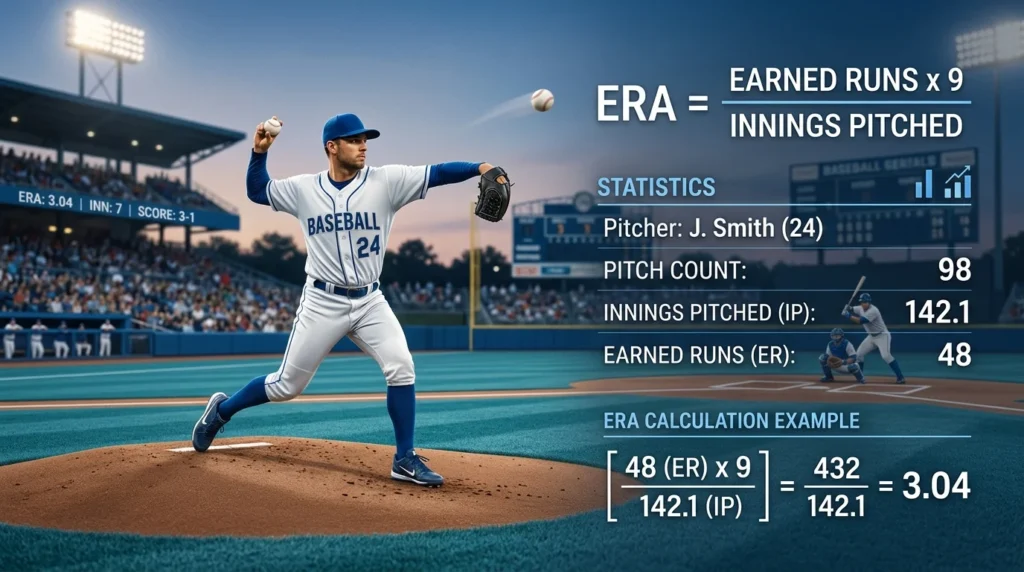
Earned Run Average (ERA) is one of the most widely used statistics in baseball for understanding a pitcher’s performance. It shows how many earned runs a pitcher allows, on average, over nine innings. Whether you are a baseball fan, player, coach, student, or fantasy baseball enthusiast, knowing how to calculate ERA can help you understand pitching statistics more clearly. You only need two pieces of information: earned runs and innings pitched. You can also use an ERA Calculator to calculate a pitcher’s earned run average quickly and check your results.
What Is ERA in Baseball?
ERA stands for Earned Run Average. It measures the average number of earned runs a pitcher allows per nine innings pitched. In a standard nine-inning baseball game, this statistic provides a way to compare pitchers who have played different numbers of innings.
For example, a pitcher who allows three earned runs over nine innings has an ERA of 3.00. Another pitcher who allows six earned runs over 18 innings also has an ERA of 3.00. Although their total earned runs are different, their average rate is the same.
ERA is useful for reviewing a pitcher’s performance over a single game, a series of games, or an entire season. However, it does not measure every part of pitching performance, so it is often considered alongside other baseball statistics.
How to Calculate ERA in Baseball
Calculating ERA is straightforward once you know the formula and have the correct statistics. The formula uses the total number of earned runs allowed and the number of innings pitched.
The ERA Formula
ERA = (Earned Runs × 9) ÷ Innings Pitched
Here is what each part means:
- Earned Runs (ER): Runs for which the pitcher is held responsible under the official scoring rules.
- 9: The standard number of innings used to express the average.
- Innings Pitched (IP): The number of innings, or partial innings, in which the pitcher records outs.
To calculate earned run average, multiply the earned runs by nine, then divide the result by innings pitched. The final number is the pitcher’s ERA.
Step-by-Step ERA Calculation
Follow these three simple steps to work out a pitcher’s ERA:
- Find the earned runs: Check the official scorebook or player statistics to find how many earned runs were charged to the pitcher.
- Find the innings pitched: Record the pitcher’s total innings, including any partial innings. Remember that baseball uses thirds of an inning.
- Apply the formula: Multiply earned runs by nine and divide by the innings pitched, using the correct innings value.
The result is usually rounded to two decimal places when presented in a box score or statistics table.
ERA Calculation Examples
Working through a few examples makes it easier to understand how the ERA formula works in real baseball situations.
Example 1: A Pitcher Allows 4 Earned Runs in 9 Innings
Suppose a pitcher completes nine innings and gives up four earned runs. To calculate the ERA:
- Earned runs = 4
- Innings pitched = 9
- ERA = (4 × 9) ÷ 9
- ERA = 36 ÷ 9
Final ERA = 4.00
This means the pitcher allowed an average of four earned runs per nine innings.
Example 2: A Pitcher Allows 3 Earned Runs in 6 Innings
Imagine a pitcher allows three earned runs during six innings of work.
- Earned runs = 3
- Innings pitched = 6
- ERA = (3 × 9) ÷ 6
- ERA = 27 ÷ 6
Final ERA = 4.50
The pitcher’s ERA is 4.50, even though the pitcher allowed only three earned runs in that appearance. The formula scales the result to a nine-inning average.
Example 3: Calculating ERA With Partial Innings
Baseball innings are divided into three outs. A pitcher who records five innings and two additional outs has pitched 5⅔ innings, written as 5.2 in standard baseball statistics.
Suppose the pitcher allows two earned runs:
- Earned runs = 2
- Innings pitched = 5⅔, or approximately 5.667
- ERA = (2 × 9) ÷ 5.667
Final ERA ≈ 3.18
The important point is that 5.2 in baseball notation does not mean 5.2 decimal innings. It means five innings and two outs. For accurate results, convert partial innings into thirds before applying the formula.
What Counts as an Earned Run?
An earned run is a run charged to a pitcher that scores without the assistance of a defensive error or a passed ball. The official scorer determines whether a run is earned by considering how the inning would have unfolded without the relevant defensive mistake.
For example, if a batter reaches base because a fielder makes an error and later scores, the run may be classified as unearned. Unearned runs are not included in the pitcher’s ERA.
However, not every run scored after a defensive mistake is automatically unearned. The official scoring decision depends on the specific sequence of plays. Also, if a pitcher leaves the game with runners on base, earned runs scored by those runners can still be charged to the pitcher who allowed them to reach base.
How Are Innings Pitched Recorded?
Innings pitched are measured by the number of outs a pitcher records. Since each inning contains three outs, one out is one-third of an inning and two outs are two-thirds of an inning.
Baseball statistics commonly use this notation:
- 6.0 IP: Six complete innings.
- 6.1 IP: Six innings and one out, or 6⅓ innings.
- 6.2 IP: Six innings and two outs, or 6⅔ innings.
- 7.0 IP: Seven complete innings.
When calculating ERA, convert this notation into actual fractions or decimal values. For instance, 6.1 IP should be entered as 6⅓, not 6.1, to avoid an incorrect result.
What Is a Good ERA in Baseball?
A lower ERA generally means a pitcher has allowed fewer earned runs per nine innings. However, what counts as a good ERA can vary by season, league, ballpark, and role.
As a general point of reference, an ERA below 3.00 is often considered strong, while an ERA around 4.00 may be viewed differently depending on the league and playing conditions. These are broad guidelines rather than fixed standards. A pitcher’s workload and the quality of the opposing teams also matter when interpreting the statistic.
It is helpful to compare a pitcher with other pitchers from the same season and league. A single ERA number does not tell the full story, especially when comparing a starting pitcher with a relief pitcher.
ERA vs. Other Baseball Pitching Statistics
ERA is an important pitching statistic, but it is not the only way to evaluate performance. Other metrics can provide additional information about a pitcher’s results and the circumstances behind them.
- WHIP: Measures walks and hits allowed per inning pitched. It helps show how often batters reach base against a pitcher.
- FIP: Fielding Independent Pitching estimates a pitcher’s performance using outcomes such as strikeouts, walks, hit batters, and home runs, reducing the influence of fielding.
- ERA+: Adjusts ERA for league and ballpark factors, allowing comparisons across different playing environments.
Using multiple statistics can provide a more complete view of pitching performance than relying on ERA alone.
How to Use an ERA Calculator
An ERA calculator makes the calculation easier when you want to check a player’s statistics or compare different pitching performances. Start by entering the number of earned runs and the innings pitched. Make sure you convert partial innings correctly if your scorebook uses baseball notation.
The calculator applies the ERA formula and returns the result. You can use it to check your own calculations, work through baseball statistics homework, or review a pitcher’s game and season totals. For accurate results, always use the official earned-run total and innings-pitched figure.
How ERA Relates to AI Sports Prediction
Baseball statistics can also be useful when exploring AI sports prediction. Statistical models may analyze pitching performance, team results, and other available game data to estimate possible outcomes. ERA is one of several metrics that can help describe a pitcher’s past run prevention, but it cannot predict a game’s result on its own. Factors such as opposing hitters, bullpen availability, weather, and defensive performance can also affect a game. Anyone exploring Ai Sports Prediction should treat model outputs as estimates rather than guarantees and consider the limitations of the data behind them.
Frequently Asked Questions
Is a lower ERA better?
Generally, yes. A lower ERA means a pitcher allows fewer earned runs per nine innings. However, comparisons are more meaningful when pitchers have similar roles and are evaluated within the same league and season.
Can ERA be calculated for one game?
Yes. You can calculate a pitcher’s ERA for a single appearance using the earned runs charged to that pitcher and the innings pitched in that appearance. A very short outing can produce a large or unstable ERA, so it is useful to consider the number of innings involved.
Do unearned runs count toward ERA?
No. ERA includes earned runs, not unearned runs. A run classified as unearned under official scoring rules is excluded from the ERA calculation.
Why is ERA multiplied by nine?
The nine represents the standard length of a regulation baseball game. Multiplying by nine expresses the pitcher’s earned runs as an average over nine innings, making it easier to compare performances with different workloads.
Is ERA the same as runs allowed?
No. Runs allowed include both earned and unearned runs charged to a pitcher. ERA uses only earned runs and adjusts for innings pitched.
Final Thoughts
Learning how to calculate ERA in baseball is a simple way to understand one of the game’s most familiar pitching statistics. Remember the formula: multiply earned runs by nine and divide by innings pitched. Pay close attention to partial innings and the official scoring of earned runs, since both can affect the result. With a little practice, you can calculate ERA for a single game or an entire season and use it alongside other statistics to better understand a pitcher’s performance.