
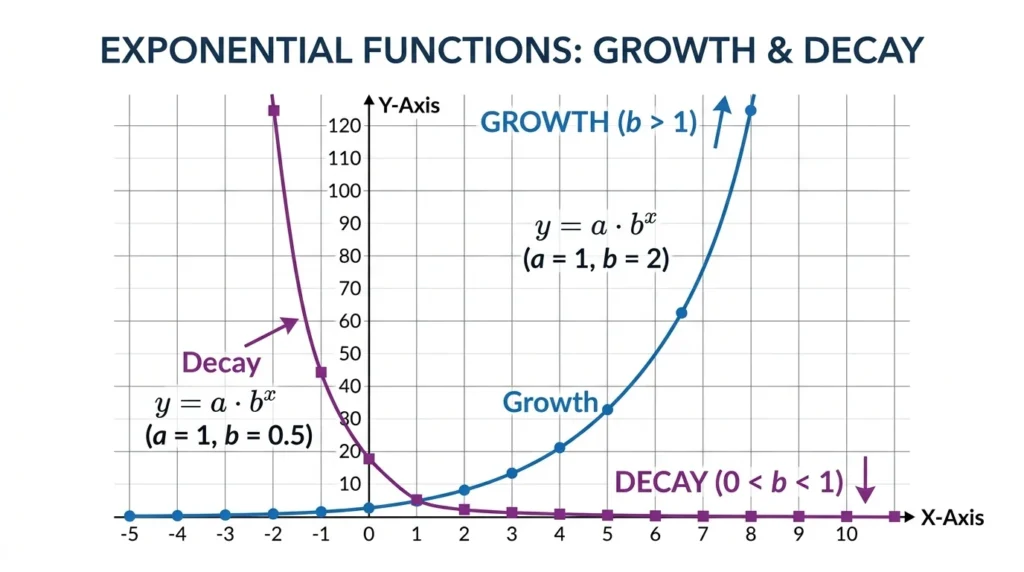
Matching an exponential function with its rate of growth or decay becomes much easier when you understand what the base of the function represents. Whether you are working on a math worksheet, studying for an exam, or solving a real-world problem, you can use a few simple steps to identify the correct percentage rate. This guide explains the formula, provides examples with answers, and shows how to practice using an Exponential Growth Calculator to check your calculations.
What Is an Exponential Growth or Decay Function?
An exponential function is a mathematical expression in which a variable appears in the exponent. It describes a quantity that changes by the same multiplying factor over equal intervals. Unlike a linear function, which adds or subtracts a fixed amount, an exponential function changes by a consistent percentage or factor. The general form of an exponential function is:
f(x)=a(b)xf(x)=a(b)^xf(x)=a(b)x
In this formula:
- f(x)f(x)f(x) is the output or value of the function.
- aaa is the initial value, or the starting amount.
- bbb is the base, also called the growth or decay factor.
- xxx is the exponent, which often represents time or the number of intervals. The base bbb is the most important part when identifying the rate of growth or decay. If the base is greater than 1, the function represents exponential growth. If the base is greater than 0 but less than 1, it represents exponential decay.
How to Identify the Rate of Growth or Decay
To match each function with its correct rate, first look at the number inside the parentheses that is raised to the exponent. Compare this number with 1. Then calculate the difference between the base and 1 to find the percentage rate.
1. Identify exponential growth
Exponential growth occurs when a quantity increases by a fixed percentage over equal intervals. In an exponential function, growth is indicated by a base greater than 1. For example:
f(x)=25(1.25)xf(x)=25(1.25)^xf(x)=25(1.25)x
The base is 1.25, which is greater than 1. Subtract 1 from the base to find the growth rate:
1.25−1=0.251.25-1=0.251.25−1=0.25
Convert the decimal into a percentage by multiplying it by 100:
0.25×100=25%0.25\times100=25\%0.25×100=25%
Therefore, the function represents 25% exponential growth per interval.
2. Identify exponential decay
Exponential decay occurs when a quantity decreases by a fixed percentage over equal intervals. Its base is greater than 0 and less than 1. For example:
g(x)=75(0.75)xg(x)=75(0.75)^xg(x)=75(0.75)x
The base is 0.75, which is less than 1. Subtract the base from 1:
1−0.75=0.251-0.75=0.251−0.75=0.25
Convert the decimal to a percentage:
0.25×100=25%0.25\times100=25\%0.25×100=25%
Therefore, the function represents 25% exponential decay per interval. Remember that a decay base represents the proportion remaining after each interval. A base of 0.75 means 75% of the previous amount remains, so the amount decreases by 25%.
The Formula for Matching Exponential Functions With Their Rates
You can use two simple formulas to identify the percentage rate of any exponential function in the standard form f(x)=a(b)xf(x)=a(b)^xf(x)=a(b)x, provided the base is positive. For exponential growth:
Growth rate=(b−1)×100%\text{Growth rate}=(b-1)\times100\%Growth rate=(b−1)×100%
For exponential decay:
Decay rate=(1−b)×100%\text{Decay rate}=(1-b)\times100\%Decay rate=(1−b)×100%
Here, bbb is the base of the exponential function. These formulas work because a growth factor includes the original 100% plus the percentage increase, while a decay factor is the proportion left after the decrease.
Math Sciences Computing Facility
+1
For example, a base of 1.08 represents a growth rate of 8%, while a base of 0.92 represents a decay rate of 8%. Both functions have an 8% rate of change, but one increases and the other decreases.
How to Match Each Function With Its Rate Step by Step
When you receive a list of exponential functions and several possible rates, use the following process to find each correct match.
- Find the base: Identify the number raised to the variable exponent in each function.
- Compare the base with 1: A base greater than 1 indicates growth. A base between 0 and 1 indicates decay.
- Calculate the difference: For growth, subtract 1 from the base. For decay, subtract the base from 1.
- Convert to a percentage: Multiply the resulting decimal by 100.
- Match the answer: Find the corresponding rate in the answer choices and label it as growth or decay.
- Check your result: Make sure the direction of change agrees with the base and that you have not mistaken the remaining percentage for the decay rate. This method is useful for matching several functions quickly, even when the starting values are different. The initial value does not affect the percentage rate, so you can focus on the base.
Examples: Match Each Function With Its Rate of Growth or Decay
The following examples show how to match different exponential functions with their percentage rates.
Example 1: Match a function with 5% growth
Given:
f(x)=100(1.05)xf(x)=100(1.05)^xf(x)=100(1.05)x
The base is 1.05, which is greater than 1. This means the function represents growth. Subtract 1 from the base:
1.05−1=0.051.05-1=0.051.05−1=0.05
Convert the result to a percentage:
0.05×100=5%0.05\times100=5\%0.05×100=5%
Answer: 5% growth.
Example 2: Match a function with 10% decay
Given:
g(x)=200(0.90)xg(x)=200(0.90)^xg(x)=200(0.90)x
The base is 0.90, which is between 0 and 1. This means the function represents decay. Calculate the difference:
1−0.90=0.101-0.90=0.101−0.90=0.10
Convert the result into a percentage:
0.10×100=10%0.10\times100=10\%0.10×100=10%
Answer: 10% decay.
Example 3: Match a function with 75% growth
Given:
h(x)=25(1.75)xh(x)=25(1.75)^xh(x)=25(1.75)x
The base is 1.75, so the function represents growth. Subtract 1:
1.75−1=0.751.75-1=0.751.75−1=0.75
Convert the result to a percentage:
0.75×100=75%0.75\times100=75\%0.75×100=75%
Answer: 75% growth.
Example 4: Match a function with 75% decay
Given:
j(x)=25(0.25)xj(x)=25(0.25)^xj(x)=25(0.25)x
The base is 0.25, which is less than 1. Subtract it from 1:
1−0.25=0.751-0.25=0.751−0.25=0.75
Convert the result to a percentage:
0.75×100=75%0.75\times100=75\%0.75×100=75%
Answer: 75% decay. Notice that a 75% decay function has a base of 0.25, not 0.75. This is because only 25% of the original amount remains after each interval.
Practice: Match Each Function With the Correct Rate
Try matching the following functions to their rates before looking at the answers. This exercise will help you become more confident when solving exponential growth and decay problems.
|
Function
|
Possible rate
|
| — | — |
|
f(x)=50(1.10)xf(x)=50(1.10)^xf(x)=50(1.10)x
|
10% growth
|
|
g(x)=80(0.60)xg(x)=80(0.60)^xg(x)=80(0.60)x
|
40% decay
|
|
h(x)=120(1.35)xh(x)=120(1.35)^xh(x)=120(1.35)x
|
35% growth
|
|
j(x)=200(0.85)xj(x)=200(0.85)^xj(x)=200(0.85)x
|
15% decay
|
Answers and explanations
- f(x)=50(1.10)xf(x)=50(1.10)^xf(x)=50(1.10)x: The base is 1.10, so the rate is 1.10−1=0.101.10-1=0.101.10−1=0.10, or 10% growth.
- g(x)=80(0.60)xg(x)=80(0.60)^xg(x)=80(0.60)x: The base is 0.60, so the rate is 1−0.60=0.401-0.60=0.401−0.60=0.40, or 40% decay.
- h(x)=120(1.35)xh(x)=120(1.35)^xh(x)=120(1.35)x: The base is 1.35, so the rate is 1.35−1=0.351.35-1=0.351.35−1=0.35, or 35% growth.
- j(x)=200(0.85)xj(x)=200(0.85)^xj(x)=200(0.85)x: The base is 0.85, so the rate is 1−0.85=0.151-0.85=0.151−0.85=0.15, or 15% decay. When checking your answers, pay attention to whether the function increases or decreases. The correct percentage alone is not enough; you also need to identify whether the rate represents growth or decay.
Common Mistakes When Matching Exponential Functions
Students sometimes confuse the base of a function with its percentage rate. For example, a function with a base of 1.20 does not represent 120% growth. It represents 20% growth because the original amount is already included in the factor. Another common mistake is treating the base of a decay function as the decay rate. A function with a base of 0.80 represents 20% decay, not 80% decay. The base tells you how much remains after each interval. It is also important not to confuse the initial value with the growth or decay rate. In f(x)=300(1.05)xf(x)=300(1.05)^xf(x)=300(1.05)x, the initial value is 300 and the growth rate is 5%. Changing the initial value to 500 would not change the percentage rate if the base remained 1.05. Finally, check that the base is written correctly. Sometimes a function is expressed as a fraction, such as (34)x(\frac{3}{4})^x(43)x. Convert the fraction to a decimal if that makes it easier to identify the rate. Since 34=0.75\frac{3}{4}=0.7543=0.75, the function represents 25% decay.
How an Exponential Growth Calculator Can Help
Once you understand how to match a function with its rate, you can use the same knowledge to calculate values after a certain number of intervals. An Exponential Growth Calculator can help you evaluate a function, explore how its output changes over time, and check your arithmetic. For example, if a quantity starts at 100 and grows by 5% each year, the function is f(x)=100(1.05)xf(x)=100(1.05)^xf(x)=100(1.05)x. You can substitute different values of xxx to see how the quantity changes. For decay, a starting amount of 100 with a 5% decrease each year is represented by g(x)=100(0.95)xg(x)=100(0.95)^xg(x)=100(0.95)x. A calculator is useful for checking your results, but it is still important to understand how the base determines the rate. Knowing the formula allows you to solve matching questions without relying on a calculator for every step.
Final Thoughts
Matching each exponential function with its rate of growth or decay is a straightforward process once you learn to read the base. A base greater than 1 indicates growth, while a base between 0 and 1 indicates decay. Subtract 1 from a growth base or subtract a decay base from 1, then convert the result into a percentage. With regular practice, you can identify the correct rate, avoid common mistakes, and solve exponential function exercises with confidence.