
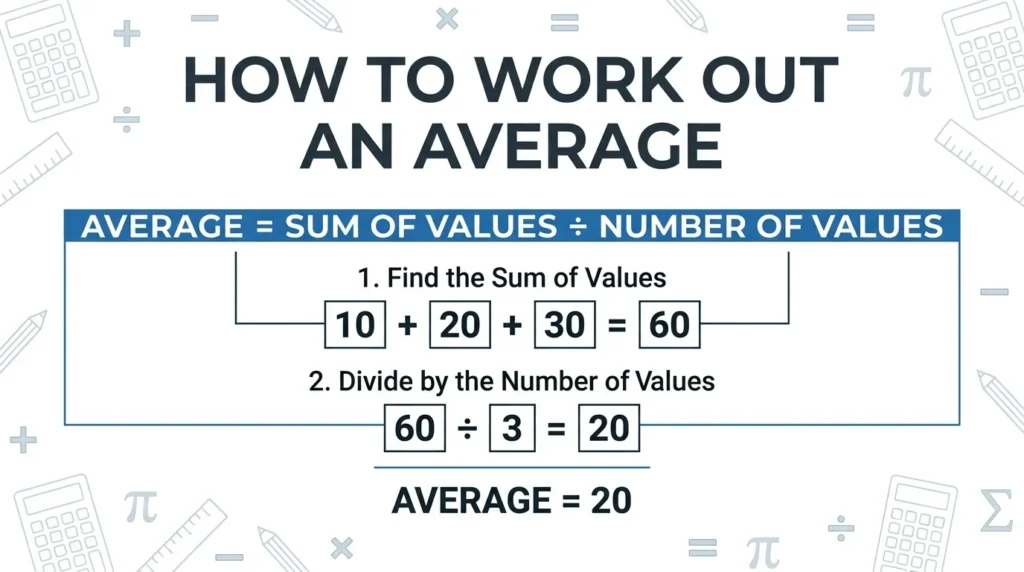
Working out an average is one of the simplest ways to understand a group of numbers. You may need an average when comparing test scores, finding typical expenses, checking measurements, or summarizing a set of results. The basic method is straightforward: add the numbers together and divide the total by how many numbers there are. If you want to check your answer quickly, an Average Calculator can do the calculation for you.
What Is an Average?
An average is a single number that represents the typical value in a group of numbers. In everyday use, the word “average” usually refers to the arithmetic mean.
For example, suppose five students receive these test scores:
70, 75, 80, 85, 90
The average gives you one number that summarizes all five scores. It does not mean that every student scored that number. Instead, it shows what the scores would be if their total were shared equally among the five students.
The average is useful because it turns a list of numbers into a value that is easier to understand and compare.
How Do You Work Out an Average?
To work out an average, follow two basic steps:
- Add all the numbers together.
- Divide the total by the number of values.
The formula is:
Average = Sum of all values ÷ Number of values
For example, consider the numbers 12, 18, 20, 25, and 30.
First, add them:
12 + 18 + 20 + 25 + 30 = 105
There are five numbers, so divide 105 by 5:
105 ÷ 5 = 21
Therefore, the average is 21.
This same method works whether you have three numbers or several hundred, as long as you are calculating an arithmetic mean.
Average Formula Explained
The average formula can also be written using mathematical symbols:
Average = (x₁ + x₂ + x₃ + … + xₙ) ÷ n
Here, each x represents one of the values, while n represents the total number of values.
You do not need to memorize the symbols to calculate an average. The important idea is simply:
Add everything first, then divide by how many values you have.
Keeping these two steps in the correct order helps prevent common calculation mistakes.
Example: Calculate the Average of Five Numbers
Let’s work through another example.
Suppose a person records the number of pages they read over five days:
20, 35, 30, 25, 40
Step 1: Add the values
20 + 35 + 30 + 25 + 40 = 150
Step 2: Count the values
There are 5 values.
Step 3: Divide
150 ÷ 5 = 30
So, the average number of pages read per day is 30 pages.
Notice that 30 does not have to be the exact value recorded on every day. It simply represents the equal share of the total across the five days.
Example: Average of Test Scores
A teacher wants to find the average score for six tests. The scores are:
72, 85, 78, 90, 75, 80
Add the scores:
72 + 85 + 78 + 90 + 75 + 80 = 480
There are six scores.
Now divide:
480 ÷ 6 = 80
The average test score is 80.
This type of calculation is commonly used to summarize grades, exam results, survey responses, measurements, and other numerical data.
What If the Average Is a Decimal?
An average does not always come out as a whole number. It can be a decimal.
For example, take these three numbers:
8, 11, 14
Add them:
8 + 11 + 14 = 33
There are three values:
33 ÷ 3 = 11
Now consider:
7, 10, 12
The total is:
7 + 10 + 12 = 29
There are three numbers, so:
29 ÷ 3 = 9.666…
The average is approximately 9.67 when rounded to two decimal places.
There is nothing wrong with getting a decimal as an average. In fact, decimal averages are very common when working with measurements, scores, prices, times, and other data.
How to Work Out an Average Quickly
For a small group of numbers, calculating an average manually is usually quick.
Use this simple routine:
Add → Count → Divide
For example:
15 + 20 + 25 + 30 = 90
There are four values.
90 ÷ 4 = 22.5
The average is 22.5.
For larger lists, however, manually adding every number can become inconvenient. A calculator can reduce the chance of making an arithmetic error and save time.
How to Use an Average Calculator
An average calculator is useful when you have several numbers and want to find their mean without doing the calculation manually.
The general process is simple:
- Enter the numbers you want to calculate.
- Make sure every value has been entered correctly.
- Run the calculation.
- Check the resulting average.
For example, if you enter 15, 20, 25, and 30, the calculator adds the values to get 90 and divides by four to produce an average of 22.5.
For a short list, you may prefer to calculate the answer yourself. For longer lists, using a calculator can make the process much faster.
Common Mistakes When Calculating an Average
Although the formula is simple, a few mistakes can lead to an incorrect answer.
Forgetting to Count All the Values
After adding the numbers, count how many values were included. Dividing by the wrong number will produce the wrong average.
Dividing Before Adding
The total should be calculated first. Once you have the total, divide it by the number of values.
Leaving Out a Number
When working with a long list, it is easy to accidentally skip one value. Double-check the original list before calculating the final answer.
Entering a Number Incorrectly
When using a calculator, check each value before submitting the calculation. A single incorrect entry can change the result.
Rounding Too Early
If your calculations contain decimals, avoid unnecessary rounding during intermediate steps. Keeping the original values until the final calculation can give you a more accurate result.
Average vs. Mean: Are They the Same?
In many everyday situations, average and mean are used to describe the same calculation: the arithmetic mean.
However, “average” can sometimes be used more generally to describe a typical value. Statistics also includes other measures of central tendency, such as the median and mode.
The mean is calculated by adding all values and dividing by the number of values. The median is the middle value when the numbers are arranged in order, while the mode is the value that occurs most frequently.
For example, consider:
2, 3, 3, 4, 20
The mean is:
50 ÷ 5 = 10
But the median is 3.
This shows why choosing the appropriate measure matters. A very large or very small value can have a noticeable effect on the mean.
When Is an Average Useful?
Averages are useful in many everyday and professional situations.
Students can use them to calculate average grades. Businesses can use averages to examine sales, expenses, order values, or customer data. Researchers may use them to summarize measurements or observations.
You can also use averages for things such as:
- Daily temperatures
- Monthly expenses
- Test scores
- Travel times
- Sports statistics
- Product measurements
- Sales figures
- Survey results
- Workout times
- Household budgets
The main benefit is that a large collection of numbers can be summarized with one easy-to-understand value.
Frequently Asked Questions
How do you calculate an average?
Add all the numbers together and divide the total by the number of values. For example, 10, 20, and 30 have a total of 60. Since there are three values, 60 ÷ 3 gives an average of 20.
Can an average be a decimal?
Yes. An average can be a whole number, decimal, or fraction depending on the values being calculated.
What is the easiest way to find an average?
For a small number of values, add them and divide by how many there are. For a larger list, an average calculator can make the process quicker and reduce manual calculation.
Does an average have to be one of the original numbers?
No. The average does not necessarily have to appear in the original list. For example, the average of 5, 6, and 10 is 7, even though 7 was not one of the original values.
What is the difference between average and median?
The arithmetic average, or mean, is found by adding all values and dividing by their count. The median is the middle value after the numbers have been arranged from smallest to largest. They can produce very different results when a data set contains unusually high or low values.
Final Thoughts
Working out an average is a simple but useful mathematical skill. The process comes down to one basic idea: find the total and divide it by the number of values. Once you understand that pattern, you can calculate averages for everything from test scores and expenses to measurements and daily records. For larger sets of numbers, an online calculator can make the process quicker while still giving you a result that is easy to check.