
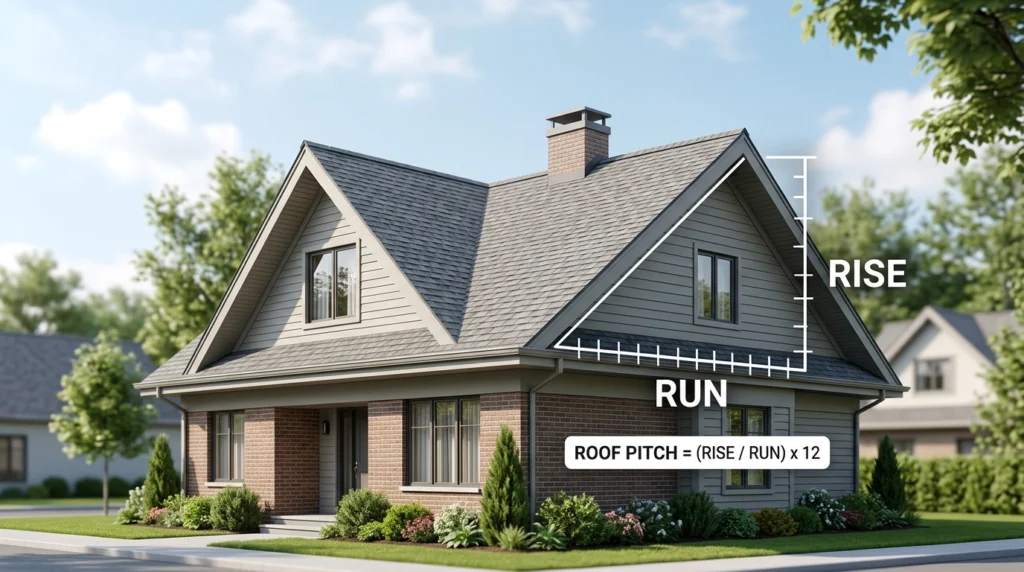
Roof pitch tells you how steep a roof is and is an important measurement for roofing, construction, repairs, and planning. Whether you are checking an existing roof or working on a new project, knowing the pitch can help you understand the roof angle, rafter length, drainage, and approximate roof surface area. If you already know the rise and run, you can quickly find the pitch using our roof pitch calculator.
What Is Roof Pitch?
Roof pitch describes the steepness of a roof. It is commonly written as a ratio showing how many inches the roof rises for every 12 inches of horizontal distance.
For example, a roof with a 6:12 pitch rises 6 inches for every 12 inches of horizontal run. A 4:12 roof rises 4 inches over the same 12-inch run, so it is less steep than a 6:12 roof.
Roof pitch can also be expressed as a percentage or as an angle in degrees. These are simply different ways of describing the same roof slope.
Understanding pitch is useful because roof steepness affects more than appearance. It can influence how quickly water runs off the roof, how much roofing material is needed, and how difficult the roof may be to work on.
How to Calculate Roof Pitch
The easiest way to calculate roof pitch is to measure the rise and run of the roof.
The basic formula is:
Roof Pitch = (Rise ÷ Run) × 12
The rise is the vertical height of the roof over a particular horizontal distance. The run is the horizontal distance covered by that rise.
For example, suppose a roof rises 6 inches over a horizontal run of 12 inches.
Pitch = (6 ÷ 12) × 12
Pitch = 6
Therefore, the roof has a 6:12 pitch.
You do not always need to measure exactly 12 inches. If you measure a 6-inch rise over a 10-inch run, you can still calculate the pitch:
Pitch = (6 ÷ 10) × 12
Pitch = 7.2
The roof pitch would therefore be approximately 7.2:12.
The important rule is to use the same unit for both rise and run before doing the calculation.
What Are Rise and Run?
Before calculating pitch, it helps to understand two simple terms: rise and run.
Rise is the vertical distance the roof goes upward.
Run is the horizontal distance from the edge of the roof toward the ridge. On a simple symmetrical gable roof, the run is normally half of the total span.
For example, if a gable roof has a total horizontal span of 24 feet, the run from one outside wall to the center ridge is 12 feet.
This distinction is important because using the full roof span instead of half the span can produce an incorrect pitch calculation for a symmetrical gable roof.
Think of the roof as a right triangle. The rise is the vertical side, the run is the horizontal side, and the sloping roof or rafter forms the diagonal side.
How Do You Calculate Pitch of a Roof From Measurements?
You can calculate roof pitch using a level and tape measure without necessarily climbing onto the roof.
One simple approach is to measure 12 inches horizontally and then determine how far the roof rises during that distance.
For example, imagine you place a level horizontally against a rafter. You measure 12 inches along the level and then measure vertically from that point down to the roof surface. If the vertical measurement is 5 inches, the roof has a 5:12 pitch.
You can also calculate pitch using larger measurements.
Suppose the rise is 4 feet and the horizontal run is 8 feet:
Pitch = (4 ÷ 8) × 12
Pitch = 6
So the roof has a 6:12 pitch.
The same calculation works with inches, feet, centimeters, or meters as long as the rise and run use the same unit.
Roof Pitch Formula
The roof pitch formula is straightforward:
Pitch = Rise ÷ Run × 12
The result is normally written as X:12.
Here are a few examples:
| Rise | Run | Roof Pitch |
|---|---|---|
| 3 in | 12 in | 3:12 |
| 4 in | 12 in | 4:12 |
| 6 in | 12 in | 6:12 |
| 8 in | 12 in | 8:12 |
| 10 in | 12 in | 10:12 |
| 12 in | 12 in | 12:12 |
A 12:12 roof has equal rise and run. This corresponds to a 45-degree roof angle.
How to Calculate Roof Angle
Roof pitch and roof angle are related, but they are not the same measurement.
If you know the rise and run, you can calculate the roof angle using the inverse tangent function:
Roof Angle = arctan(Rise ÷ Run)
For example, with a 6:12 roof:
Angle = arctan(6 ÷ 12)
The result is approximately 26.6 degrees.
A 4:12 roof is approximately 18.4 degrees, while a 12:12 roof is 45 degrees.
This conversion can be useful when a roofing specification, building plan, or other reference gives the roof angle instead of the pitch ratio.
Common Roof Pitch Examples
Different buildings can have very different roof pitches. A low-pitch roof has a smaller rise compared with its run, while a steep roof rises more quickly.
For example:
2:12 pitch: A relatively low slope.
4:12 pitch: A moderate roof slope.
6:12 pitch: A common example of a moderately steep residential roof.
8:12 pitch: A noticeably steeper roof.
12:12 pitch: A steep roof with a 45-degree angle.
These examples are useful for understanding roof geometry, but there is no single pitch that is suitable for every roofing material or building. Minimum slope requirements can depend on the roofing product, installation method, climate, and applicable building requirements.
How to Calculate Rafter Length From Roof Pitch
Once you know the rise and run, you can also calculate the length of the sloping rafter using the Pythagorean theorem.
The formula is:
Rafter Length = √(Rise² + Run²)
For example, if the rise is 6 feet and the run is 12 feet:
Rafter Length = √(6² + 12²)
Rafter Length = √180
Rafter Length ≈ 13.42 feet
This represents the basic sloping length from the end of the run to the ridge. Actual rafter cutting dimensions can be different because of overhangs, ridge details, cuts, and other construction requirements.
Why Roof Pitch Matters
Knowing the roof pitch can be helpful for several reasons.
First, pitch affects water drainage. In general, a steeper roof allows water to move off the surface more quickly than a very low-slope roof.
Second, pitch affects the actual roof surface area. As the roof becomes steeper, the sloped surface becomes longer than the horizontal footprint below it.
Third, pitch is important when estimating roofing materials. Shingles, metal panels, tiles, underlayment, and other materials may have specific installation requirements based on roof slope.
Finally, a steep roof can make access and maintenance more difficult. For safety reasons, roof work should be approached carefully, particularly on steep or wet surfaces.
Calculate Roof Pitch With Calculate Wiki
If you already have the rise and run measurements, you do not have to work through the formula manually.
A roof pitch calculator can quickly determine the pitch from your measurements and can also help you understand related measurements such as the roof angle and slope percentage.
For example, entering a 6-inch rise and 12-inch run gives a 6:12 pitch. The same measurements correspond to a slope of 50% and an angle of about 26.6 degrees.
Using a calculator is especially helpful when comparing several roof sections or checking calculations before using them in a project.
Frequently Asked Questions
What is the easiest way to calculate roof pitch?
Measure the vertical rise and horizontal run, then use the formula (rise ÷ run) × 12. The result gives the pitch in the common X:12 format.
How do you calculate pitch of a roof without climbing on it?
You may be able to measure the rise and run from an accessible area such as the attic, a gable end, framing plans, or another safe location. A level and tape measure can also be used when a suitable measurement point is available.
Is a 6:12 roof steep?
A 6:12 roof rises 6 inches for every 12 inches of horizontal run and has an angle of approximately 26.6 degrees. Whether it is considered suitable for a particular roofing material depends on the product requirements and applicable building rules.
What is a 12:12 roof pitch?
A 12:12 roof rises 12 inches for every 12 inches of horizontal run. Because the rise and run are equal, the roof angle is 45 degrees.
Are roof pitch and roof angle the same?
No. They describe the same roof steepness in different ways. Pitch is commonly expressed as rise per 12 inches of run, while roof angle is expressed in degrees.
Final Thoughts
Calculating roof pitch is easier than it may seem. Once you know the rise and run, you can use a simple formula to determine the pitch and convert it into an angle or percentage when needed. Understanding these measurements can make roof planning, material estimates, and basic roof assessments much easier. Click Here to Explore our Calculators.